Showing posts with label Everest. Show all posts

Thursday, August 1, 2013

Just Start!

“Whatever you can do, or dream you can, begin it. 
Boldness has genius, power and magic in it.” –Goethe

I believe that we let obstacles and excuses get in the way of our dreams.  This first statement may seem odd from people who enthusiastically sign up to have 20+ obstacles put in their way on any given weekend.  The obstacles we face whether real or imagined can be conquered just like a Tough Mudder course.  


You may get KNOCKED OUT going through the wires but you get back up.  You may fall off of the Funky Monkey but you keep swimming out and you conquer it the next time (or in my case you swim again).  You may fail scaling Everest and fall back down but you find a way to get back up.  The honest truth is that if you cannot go through an obstacle you always have the option of going around.  On our team you will never hear the end of it if you go around but it does technically remain an option.  We have changed a lot on this journey and some of these lessons can be translated into leadership and education arenas.

Pay close attention to conversations about change.  The focus is typically on "what could be?" or "why we cannot do things differently".    Very little time is spent on the actions that need to take place.  We can debate the change that should occur in our world, lives, education, etc.  The unfortunate thing is that nothing changes unless someone is bold enough to begin it.  I have a couple of questions to ask as we wind down the present school year and plan for the next.  
  1. What are you bold enough to change?
  2. What actions are you willing to take to accomplish the change?
  3. How can we change conversations to focus on what truly matters?
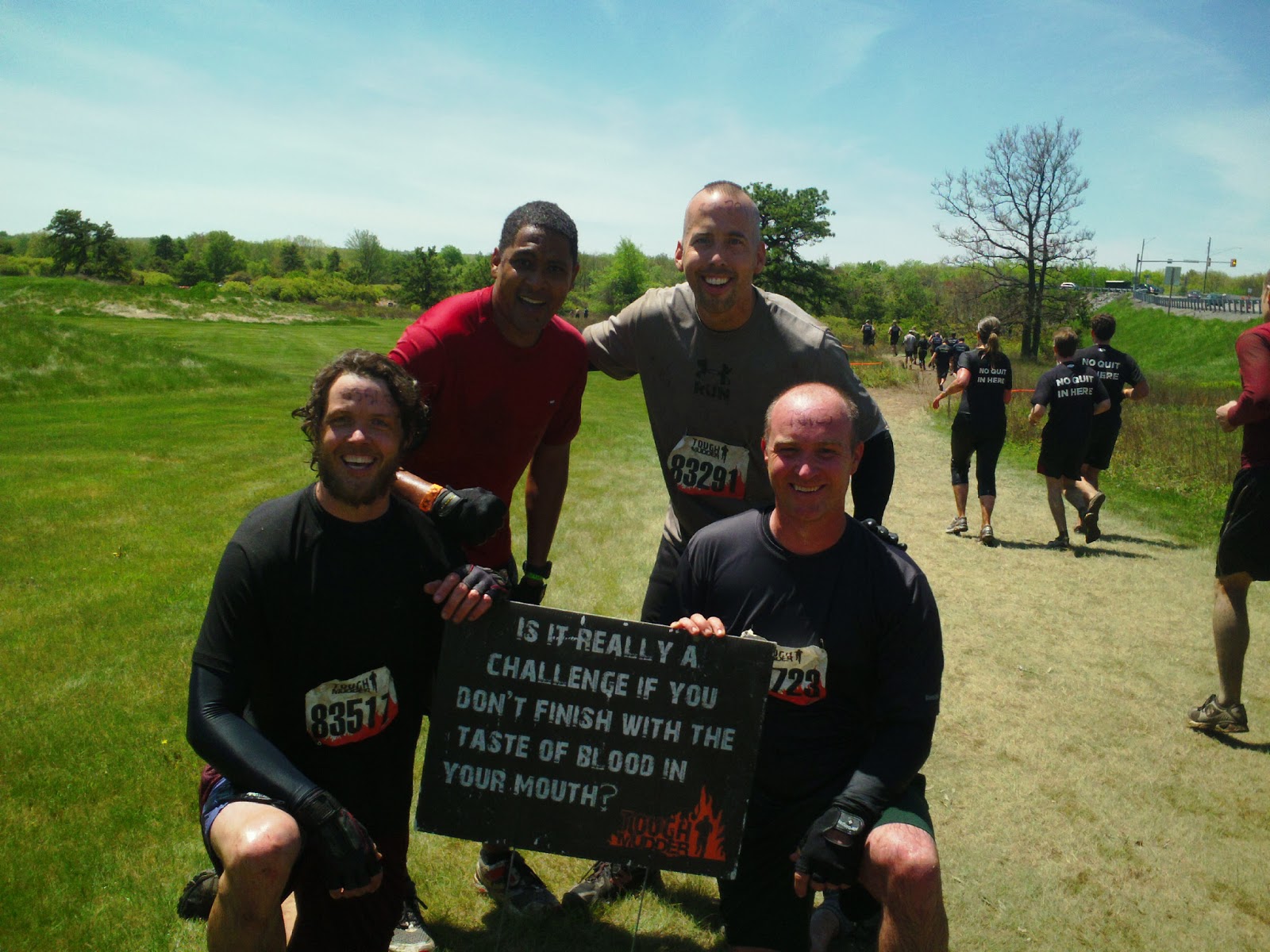
The most important thing is that we opt to be bold, take action, and enjoy the moments that follow.  Conquering your biggest obstacle typically leads to moments like the ones captured in the pictures below.


Monday, March 25, 2013

Conquering Everest

Everest is an obstacle that you will encounter at every Tough Mudder event.  This obstacle has spawned multiple posts from us including 3 Leadership Lessons from Everest.  It is also an event that we have seen varying degrees of success with.  That's part of what makes this experience so much fun.  Each event, each obstacle brings with it a new challenge.  I've posted my Everest failure clip on a previous blog post.  There is no need to relive that tragedy yet again.  I thought I'd post my Everest success clip instead.


It's still amazing to look back to the first event at Wintergreen and see multiple failed attempts with a great deal of assistance.  It ended up taking an army of people to hoist me over the ramp.  Now it is entirely possible to scale the obstacle without any help at all.  It just goes to prove that Impossible is Nothing.  The countdown clock is moving fast and Mid-Atlantic will be here in a few short weeks.  New course, new obstacles, and new challenges await!


Wednesday, March 6, 2013

10 Questions Answered in Miami (Sort Of)


We began a 10 day series that posed a different question that we intended to answer at the Miami Mudder.  Some of these questions involved the team while others were directed at particular team members.  We were able to answer most of the questions in Miami.  A few will follow us to the Mid-Atlantic Mudder.  There is certainly a longer story or post behind each question but the short answers are below.

I'm sure DC and Patrick will be weighing in on this one as well.  It was definitely a challenge to run both days even though we actually ran faster the second day.  It could be the fact that we missed all of the official starts and had to make up time on Sunday.  

Yes we can.  There were no major setbacks on either day.  We didn't lose anybody or need the assistance of the medics along the course.

The answer to this question is still up in the air as the obstacle did not make an appearance in Miami.  While that obstacle did not appear we all developed a healthy aversion to the shocking obstacles.  The voltage seemed to be turned up this time on South Beach.  Check out the Amped Up videos here if you need additional proof!

This question was answered with a resounding "Yes" on both days.  As promised we captured video of this accomplishment which you can find here.

All of the regrouping that was noted through DC's posts paid off in a big way.  The shoulder and knee both held up remarkably across 24 miles and 44 obstacles.

Honestly, this really did not have a measurable impact.  I enjoyed not knowing what to expect as we went through the course.  

We had a varied degree of success on this one.  Patrick scaled the ramp without assistance while DC's shoulder/knee would prevent his unassisted triumph.  This obstacle is also where it went all downhill for me on Saturday.  I was determined to use the spiderman technique and scale the wall by myself.  I was able to scale the wall by myself but I felt a pop in my calf as I reached the top.  I knew this feeling well because I have torn my calf a couple of times.  This would not spell bad news for "Team Bad News" as we went on to successfully finish Saturday's race and run even faster on Sunday!  


3.  How will the heat impact running the course in Miami?
The heat did not impact the course at all in Miami.  The heat actually did not really make an appearance until late in day 2.  DC and I agree that the first day could have been the coldest mudder ever.  Patrick disagrees since we ran Wintergreen when it was 39 degrees.  The weather ended up being a perfect balance for the obstacles that were placed on the course.

2.  What type of crazy mohawk will DC and I attempt to pull off in Miami?
Miami marked the first ever appearance of the sidehawk for DC.  Patrick had the locks flowing and I went with the standard hawk.  Patrick took pictures and documented it which you can find here.

1.  Will this be the race that we qualify for the World’s Toughest Mudder?
Time will tell with this question.  We put up good times on both days.  We are also developing some strategies for Mid-Atlantic to cut additional time from our run.  Once we qualify you will be the first to know!

We are 45 days away from the next Mudder.  We learned a lot of lessons about ourselves and our team that we will share in the weeks leading up to Mid-Atlantic.

Monday, February 25, 2013

T-Minus 4 Days: Scaling Everest


4.  Can we scale Everest without any help from teammates and fellow mudders?


Patrick may have already accomplished this and I just missed it because I was trailing.  Everest has been a barometer for our progress on this journey so far.  The Wintergreen Mudder provided many lessons in failure while we attempted to scale this obstacle for the first time.  You can even check out some Leadership Lessons Learned From Everest by clicking here.  One of the best moments of this entire journey so far was in Pennsylvania when we all successfully completed this obstacle for the first time.  It was in the middle of the celebration that I saw two guys run right up and over Everest unassisted.  I knew that this had to be the next challenge.  It almost happened in Carolina but mudders are so helpful that assistance was provided even if not needed.  Miami provides another attempt at scaling Everest.

Sunday, February 24, 2013

T-Minus 5 Days: Fear of the Unknown


5.  How will not knowing the obstacles and order of events impact our approach on the course?


We are five days away from our start in Miami and we still haven’t seen a course map.  We typically get a sneak peek at the course outline several weeks ahead of the start.  The maps are not always entirely accurate but you get a glimpse of what the course will bring.  This time will be completely different for us.  We have no idea what the course will look like other than the generic sample map that is included for every course.  I am excited to see the addition of some new obstacles in the events leading up to Miami.  One of the great things about running these courses is that you can test your progress against known obstacles (Funky Monkey, Everest, etc.) while seeing how you can adapt to newer obstacles.  I'd like to put a plug in for the reappearance of the "Twinkletoes" obstacle in Miami.  I need to see if our resident yoga master DC can do the "Warrior 3" across the obstacle. In 5 days we will be heading into Miami with signed death waivers and a very limited knowledge of the challenges that this course will present.  We'll be sure to post the actual course map post-mudder!

Thursday, February 14, 2013

Effort vs. Talent

I used to have an adviser in college who would ask me the question "What should be valued more: effort or talent?" and I never seemed able to answer it.

My initial inclination was to value effort more - because, after all, haven't we always heard that we can succeed if we simply work harder than anyone else.  Isn't it better to work hard than to have things handed to you?  He, on the other hand, would always say that talent was more important, and that success should be judged on results not on the process.  I'm not quite sure how much of that was just him playing Devil's Advocate a bit, though.  In the years that have passed since we had this conversation, I never got the sense that he truly felt that way.  Rather, knowing what I know of him, he probably was simply trying to get me to question my "knee-jerk" reactions (emphasis on the "jerk" part), and really felt that neither of them was MORE important than the other.  I'm not naive enough to think I have a definitive answer to this conundrum, but it's something that came into my mind recently.

With the dawning of my 5th decade on this planet, I no longer think that effort is more important, and have settled into the opinion that these two variables work together to create success. Situationally, I suppose that an individual can overcome deficiencies through applied effort, and other individuals can float by on talent without really applying themselves, but I would suspect that those would be the extreme ends of the normal curve.  Most of us, I would guess, have unique talents that are either exploited or wasted depending on the effort that we put into cultivating them.

I've started to wonder how these two things work together, and what I can learn about myself from viewing how I've applied my talents and my efforts.  For a great portion of my life I was an adequate athlete that didn't really try very hard.  I played football, basketball and ran track and field in High School, but didn't live and breathe any of these sports.  I enjoyed practice, but didn't always focus.  The same goes for academics.  I was considered a good student because I knew the "game" of school and could remember most things that I saw or heard.  I would do my homework on the bus to school or between classes, and I was able to maintain a high-B/low-A average throughout school without really trying to hard.  In both instances, I would guess that I was above average in terms of talent and either average or slightly below average in terms of effort.

That's flipped a bit since I started trying to get in shape.  I spent my 20's and a good amount of my 30's sitting behind a computer for a living.  This lead to a sedate life and an expanding waistline.  Once I made the decision to get in shape, I had to learn how to put effort into the tasks that used to come naturally.  I couldn't lose weight by simply drinking fewer beers...I had to actually get on an elliptical and work it off.  I had to work for those things that talent used to afford without much effort.  Seeing results made the effort worthwhile, and made me see the utility of redoubling those efforts.  This process has brought me through 4 laps at 3 Tough Mudders, and I feel as if I'm absolutely on the right path for success at my Tough Mudder challenges this year (and I may even be able to get across those damn monkey bars)

So, what does this all mean for education?  The lesson that I've learned is that we need to provide guidance on both of these variables if we want to engender success.  And, by guidance, I don't mean simply telling people that they are important.  We need to demonstrate each of these things in practice.  As teachers, we need to demonstrate our skills and our efforts, and make it overt that we are doing so.  It is only through modeling of these behaviors that we can hope to convince students that they should also be putting effort into those things that might come easily otherwise.  If we can do that, then maybe our students won't have to be smacked by the expanding waistline before seeing the importance of melding effort and talent to get where they want to go.

Wednesday, January 30, 2013

Approaching Each Obstacle: Part 2

This is a follow-up post to Part 1. As with Part 1, I'll be a bit more specific about my approach to the obstacles that a Mudder might include.  In this case, I'll take the obstacles as they happened in Society Hill, SC last October.  I'll describe each obstacle, give my impressions, and then define my approach to that particular one.

Official Course Map from Toughmudder.com
  1. Log Jammin': This obstacle is made up of a series of log walls that you have to navigate.  The walls themselves are high, but they are staggered so you have to do some crawling.  The intention is to get you to climb over one wall, then go under the next, then climb, then crawl, etc.  If it's busy, and lots of people are going through, then you'll have to suck it up and do the climbs and crawls, but there is another way if the challenge isn't all that busy.  I'll do pretty much anything I can to avoid crawling (if I can), since I hate getting my knees and legs all scratched up, so my method for this obstacle is to climb over the walls, and then lay down and roll under the crawling walls.  This works pretty well if there aren't many people there, but you should be careful to look at the ground where you'll be rolling.  I actually got a pretty big rock to the lower back on this obstacle in SC, so be careful.
  2. Mud Mile: This tends to be a large open pit filled with mud.  In SC it was a little bit different, but not so much so that it makes a difference.  The key is to just keep moving (you'll want to make sure that you have your shoes tied on tight though).  I will say, the SC mudder was the muddiest mudder we've participated in, and it really showed up on this event.  I had a blast getting into the mud and slogging my way through.
  3. Dong Dangler: This event requires you to get across from a stand on one side of the water to the other shore climbing across a wire strung between two locations.  I've seen two ways to do this.  The first is to hang below the wire and shimmy hand over hand.  The second is to balance on top of the wire and pull yourself across.  The first option requires a good amount of upper body strength as your entire weight is suspended and all of the effort is put into moving the shoulders and holding on with your hands.  The second requires you to straddle the wire with one leg hooked on.  The SC mudder was the first that I attended that actually had this obstacle, so we went with option number one.  Needless to say, it didn't go very well.  We all made it a good distance across during our first lap, but barely made it any of the way on the second lap when upper body strength was gone.  I vividly remember thinking "just get past the rocks at the starting point so you can let go and fall into the water".  Prepare to get wet, though, because I didn't see many people making it all the way across.
  4. Underwater Tunnels: This is a little misleading, because there aren't actually any tunnels involved.  Rather, you have to swim out to a series of barrels floating on the surface of the water (don't worry, they're tethered in place) and then go under them in sequence.  It's not too tough, but if you're not a good swimmer, then you may want to skip this because the water is deep enough that you'll have to swim.  The key for me was using my hands to hold on to the braces holding the barrels in place and use them to pull my way.
  5. Kiss of Mud #2: Same as Part 1, but it's much more likely that the crowd will have thinned out a bit by now so rolling should be possible. 
  6. King of the Mountain: This was more fun that I thought it would be.  It's a series of two "mountains" made out of hay bales.  Each side was stepped, so you can climb, but my approach was to lift with my arms and then twist so that I ended up sitting on the edge of the bale.  Then I would get up and do it again with the next step.  Going down the other side was a pretty simple slide from one level to the next.  The final part of the obstacle was the large roll of hay (maybe 5 feet tall) that you had to climb across.  They gave us plenty of room to get a running start, so it wasn't too difficult to jump, grab on and pull yourself over, but one of our team members (none of the authors of this blog) was so beat by the time he got here that he couldn't get over and an un-named mudder got down on hands and knees to let him step up on his back.  Talk about taking one for the team...
  7. Hangin' Tough: The Rings Obstacle.  If you are of a certain age, you'll remember having to navigate the rings in gym class.  This is basically the same thing, just over water.  There are about five or six rings hanging down from a wooden structure, and you have to swing from one to the next to make it across.  I've seen people actually put their whole arm up to the elbow into the rings and hold on that way, but we chose the simpler grab with the hand approach.  Brian made it across during the first lap (although he did lose his balance on the other side and fell into the water, so I only give him partial credit), and he saved a dude's life on this obstacle during the second lap.  Since neither Danny or I made it across in either lap, Brian is the unequivocal winner of this obstacle for SC.
  8. Funky Monkey: This is the bane of my existence, and there is visual evidence of my failure.  It sounds easy enough...monkey bars in a slight inverted V shape.  You get from one edge to the other without falling in the water.  The first mudder we did in Wintergreen had this, and I missed a bar and fell pretty quickly.  The second mudder in Pocono I made it to the very last bar, which I missed and fell.  As disappointing as that was, I was horrified to see my failure advertised in the official Facebook pictures of the Saturday Pocono mudder (I'd link to it, but the memory is too painful).  Imagine hoping that your picture would be one of the chosen ones to be included in the official set of Facebook photos, and then seeing that the chosen image is actually of your biggest failure.  Unfortunately, SC didn't go much better.  I actually made it most of the way across, but a guy next to me was swinging pretty badly and caught my leg (throwing me off stride).  I have yet to make it all the way from landing to landing, but I absolutely plan on crushing this event in Miami.
  9. Boa Constrictor: A set of tube tunnels that you have to get through.  The first ones are angled downward towards a pit of water, and the second set are angled up from that pit.  The ones going down are pretty easy...get in, and you can almost slide down.  The ones going up are more difficult.  The tubes are too tight for most people to crawl, so you end up having to scrabble using whatever method you can to get up.  I tend to struggle on this because I try to bring my knees up.  It works, but it's slow going.  I know other people who go up on their sides or on their backs, but I've never been able to master that.  In SC, at least during the second lap, the mudder support crew put in place ropes on some of the inclined tubes so you could pull yourself up, but that seems a little too much like cheating for me so we didn't use them.
  10. Everest: The quarter-pipe that you have to climb.  I've seen two distinct approaches to this.  The first, which most people employ, is running and grabbing for someone's hand.  The second, which is used when people are having real difficulty or are in special need, is that a group of people will lay down on the quarter-pipe to create a makeshift ladder that people can climb.  I've come to realize that the key to this is that you need to run through the obstacle.  Don't run to the goal...run through the goal.  Don't run just enough to get to the hands (or the support 2X4 along the edge).  If you run just to reach those, you'll probably fall short.  The key is to run through those things.  Don't think of reaching for a hand...keep running.  Don't just try to reach the edge...keep running.  We all made it up this obstacle both laps at SC, and it's become much less daunting.
  11. Electroshock Therapy: This has been talked about before (Brian has a whole post about leadership lessons to learn from it).  The thing to realize is that you will be shocked, but you have to keep moving.  As with electric eel, the faster you move, the less the effect will slow you down.  As this is the last obstacle in every Mudder, we've gone through it in several different ways.  We've gone fast, we've gone slow.  The only thing we haven't done (yet) is to go through with your arms spread wide out.  The shocks aren't all that bad, in that they don't last long, but the will get you. If you want to minimize their effect, go fast.  If you want to savor it a bit, walk through and embrace the effects.
Anyway, that's the end of my post about how I approach the various obstacles at Mudders.  I'm not sure there's much to learn here about leadership or education, other than maybe to embrace the challenges that come your way.  Prepare for them, obviously, but embrace them regardless.  It's only by confronting them head on that you can actually succeed consistently.

Sunday, January 13, 2013

The Secret Formula to Excellence


"Researchers have settled on what they believe is the magic number for true expertise: 
10,000 hours."
- Malcolm Gladwell

I was rereading the book Outliers recently and came across the quote above.  There really is no easy road to expertise and excellence.  There will also be no easy path to the World's Toughest Mudder.  The truth is that many people give up before they can realistically see improvement.   The other scenario is that people get just good enough and settle.  Good is often the enemy of great for most people.  This is true with piano lessons, diets, and in the workplace.  As a group we have gotten pretty good at completing the courses that are thrown at us by Mother Mudder.  We have completed the course four times in three different states.  We could settle with being pretty good at doing that or we can look at the challenges that still exist.  There are obstacles that still present a challenge or we as a group have not completed together.  

For example:

Author's Note:  I intentionally chose three obstacles where I was in the numerator.  

We are also looking forward to climbing Everest without assistance and completing Dong Dangler/Ball Shrinker (0/3 have successfully completed).  There are obstacles that we have not encountered yet but are eagerly looking forward to conquering.  I could never climb the rope in gym so I am ready for revenge if the rope climb comes my way again.  We have become adept at taking on new challenges such as running two laps in Carolina or running on both Saturday and Sunday in Miami.  The point of these challenges is to keep us from falling into either of the two scenarios.  We will not settle for good or give up if we fail to complete a challenge.  We will run farther and train harder.  We will even take to extreme measures like building homemade rings to hang in the garage or spending far too much time on playgrounds traversing the monkey bars.  


Release Forms Will Be Standard on This Mission
People are often looking for the secret to greatness.  The secret all starts with your personal passion.  This year in the mud has ignited a passion in the three of us.  This passion spans fitness, education, and leadership.  Once you understand the first ingredient...the rest of the formula falls into place.  Understanding the formula is not difficult.  Putting the formula into practice is what ultimately separates good from great.  We may end up outliers or just completely crazy.  Either way this will be a memorable 10,000 hours.

Friday, December 21, 2012

3 Leadership Lessons From Everest


The obstacles that you encounter at Tough Mudder can be exciting, scary, dangerous, and flat out insane (see any of the electroshock obstacles) all at the same time.  One of the signature obstacles that you will see on every course is Everest.  Everest is billed as a quarter-pipe that you will have to sprint up and enlist the help of other competitors to pull you over this beastly summit. To make matters more difficult, Everest is always coated in mud and grease.  This combination which will likely send you right back from where you came. Check out my epic fail on this event in my first ever attempt.  


There are numerous leadership lessons that you can learn from this obstacle which we have now faced four times and will be seeing again soon in Miami.  Here are three to get us started.  I'm quite sure DC and Patrick will have their own thoughts on these.

Vision - The first thing you do when you reach the obstacle is to make eye contact with someone at the top of the ramp.  Although we have just started to be able to get up without assistance you always need someone on standby.  Once you have initiated the eye contact, you know have a clear path to the top.  


Leaders must know where they are trying to go and help others navigate the path.  

Team -  One of our fellow mudders who will likely join us for some events in 2013 had some troubles with the obstacle which required the help of many (including two Tough Mudder staff members).  He was able to reach our hands on the first attempt but that was where the progress stopped.  We were not able to pull him up and he was unable to provide much assistance.  At this point several people ran over to help and with the support of others we were able to haul him up.  Exhausted but victorious....This was one of my favorite moments on the course since it took all of us to help.  You can see us waiting for his arrival in the picture below.


Vision is important but it will ultimately require a team of committed people to accomplish the goal.


Learning from Failure -  You've already seen my epic fail during my first attempt.  I learned several things through that failure and by watching others suffer a similar fate.  The first thing that I learned was that speed will be your best friend and a lack of it will be your downfall.  The other interesting piece was that people made the mistake of jumping before they reached the top.  You can actually run all the way up the ramp if you ignore the vertical piece of the ramp and keep running.  Once again speed will be the key.  Many people jump as the ramp becomes vertical and the fall short.  Those fails not only help you learn a better way to complete the obstacle they also make for hysterical bloopers.


Failure is only fatal if you don't learn something in the process.  
Learning from failure is typically the key to moving any initiative forward. 

I always look forward to this obstacle for several reasons.  The first is that it typically means the end of the race is near and the celebration with your team can begin.  The second reason has to do with the interactions you have with teammates and fellow mudders.  We have all written about how we are drawn to these challenges because of the camaraderie.  Camaraderie abounds throughout the course but it all comes together at Everest.  

I look forward to reaching the top of Everest many more times in 2013 and learning more lessons about myself and our team.